































Plate Techtonics: Is the Earth getting Bigger?
Monday, December 29, 2003 by joetheblow | Discussion: WinCustomize Talk
Where are all the science freaks around here???
http://www.sciencegroups.com/viewtopic.php?t=5445
I have always been amazed by plate techtonics and all this 'one plate going under or over' business.
Well in this thread on the linked site, one guy is saying that maybe the theory behind plate techtonics are wrong.
What do you think? And for that matter I thought plate techtonics was a law not a theory.
http://www.sciencegroups.com/viewtopic.php?t=5445
I have always been amazed by plate techtonics and all this 'one plate going under or over' business.
Well in this thread on the linked site, one guy is saying that maybe the theory behind plate techtonics are wrong.
What do you think? And for that matter I thought plate techtonics was a law not a theory.
 |
|
Page 1 of 3 | |
|
|---|
sig101
Reply #2 Monday, December 29, 2003 1:40 AM
Reply #2 Monday, December 29, 2003 1:40 AM
Plate tectonics is not a physical law (like the laws of physics for example). Roughly speaking it's an observation and explanation, based on evidence of where things were and are now, of how continents have moved and how things are still moving. Continental drift, creation of mountains, etc. Like there was at one time Pangaea where all the currently known continents were all in one piece and now we have them split out. Like the San Andreas fault being where two plates meet and the Pacific plate is shoving up against (and under as I recall) the North American continental plate. So it's a theory in that it is an explanation of how things were, are and work. Not an immutable physical law.
Heres a US Geo Survey site with a sort of brief primer on plate tectonics http://pubs.usgs.gov/publications/text/dynamic.html

Heres a US Geo Survey site with a sort of brief primer on plate tectonics http://pubs.usgs.gov/publications/text/dynamic.html

Erk.
Reply #3 Monday, December 29, 2003 1:45 AM

Reply #3 Monday, December 29, 2003 1:45 AM
Just to take this a little sideways... I read in National Geo that about 10 tonnes of space 'dust' makes it thru the atmosphere, and falls to earth every day 


joetheblow
Reply #5 Monday, December 29, 2003 2:02 AM
At first I thought it was allot. I mean 10 tons! Sheesh.
But when you think about the surface area of the Earth's atmosphere it comes out to being very little if nill.
So this plate techtonic stuff is a theory? I really thought it was a law.
I do wonder how all this works. Like for example the Earth's crust is only so many miles thick (as I last read) so what is the rest of it? Molten rock?
So then there would be no way to travel to the center of the Earth unless you want to see allot of lava.

Reply #5 Monday, December 29, 2003 2:02 AM
| #3 by WrecklessEric - 12/29/2003 1:45:33 AM Just to take this a little sideways... I read in National Geo that about 10 tonnes of space 'dust' makes it thru the atmosphere, and falls to earth every day |
At first I thought it was allot. I mean 10 tons! Sheesh.
But when you think about the surface area of the Earth's atmosphere it comes out to being very little if nill.
So this plate techtonic stuff is a theory? I really thought it was a law.
I do wonder how all this works. Like for example the Earth's crust is only so many miles thick (as I last read) so what is the rest of it? Molten rock?
So then there would be no way to travel to the center of the Earth unless you want to see allot of lava.
Aleatoric
Reply #6 Monday, December 29, 2003 12:44 PM

Reply #6 Monday, December 29, 2003 12:44 PM
Plate tectonics as a whole is the theory of crustal plate movement and the mechanisms that cause it. The actual movement of the plates is an observed characteristic. The confidence in the evidence in favor of plate tectonics as a valid theory is quite high.
The crust of the earth averages about 30 miles thick, although it can be quite thin in places. It 'floats' on the mantle, which is the outer layer of the earths core, which consists of what we call magma, which is primarily molten rock. The mantle surrounds the outer core, which is composed of molten rock and metals, mostly iron and nickel. The outer core surrounds the inner core, which is molten iron and nickel, compressed to near solidity by the pressure.
The crust of the earth is broken into several pieces, or plates, and these rub up against one another at the edges. Where the plates meet, one of several things happen. One plate can be forced under another plate, called subduction. Usually this is accompanied by fault lines and upheaval (the pacific plate is subducting (moving under) the north american plate. Or both plates can buckle upward, which generally results in the larger and higher mountain ranges (the himalaya mountains are an example of this type). Or the two plates can move apart from each other, with the gap being filled by magma (the mid atlantic ridge is a result of this movement).
Crustal movement will not change the size of the earth, as the mass and volume remain relatively constant.
As for space borne dust, 10 tons a day is about 90.9 * 10^2 kilograms. The mass of the earth is about 5.97 * 10^24 kilograms. The amount of new mass as a percentage of the mass of the earth is about 0.0000000000000000000152 %. This would have to continue for about 6,578,947,368,421,052,631 days to make a 1% increase in mass.
The crust of the earth averages about 30 miles thick, although it can be quite thin in places. It 'floats' on the mantle, which is the outer layer of the earths core, which consists of what we call magma, which is primarily molten rock. The mantle surrounds the outer core, which is composed of molten rock and metals, mostly iron and nickel. The outer core surrounds the inner core, which is molten iron and nickel, compressed to near solidity by the pressure.
The crust of the earth is broken into several pieces, or plates, and these rub up against one another at the edges. Where the plates meet, one of several things happen. One plate can be forced under another plate, called subduction. Usually this is accompanied by fault lines and upheaval (the pacific plate is subducting (moving under) the north american plate. Or both plates can buckle upward, which generally results in the larger and higher mountain ranges (the himalaya mountains are an example of this type). Or the two plates can move apart from each other, with the gap being filled by magma (the mid atlantic ridge is a result of this movement).
Crustal movement will not change the size of the earth, as the mass and volume remain relatively constant.
As for space borne dust, 10 tons a day is about 90.9 * 10^2 kilograms. The mass of the earth is about 5.97 * 10^24 kilograms. The amount of new mass as a percentage of the mass of the earth is about 0.0000000000000000000152 %. This would have to continue for about 6,578,947,368,421,052,631 days to make a 1% increase in mass.
aufisch
Reply #7 Monday, December 29, 2003 4:02 PM

Reply #7 Monday, December 29, 2003 4:02 PM
I am not a Geologist but I am a Biologist and there are some inidicators there that suggest that our planet must have been smaller with a smaller gravity. There are many theories currently discussed about whether some of the bigger dinosaurs would have actually been able to survive in 1G or wether they would have been simply crushed together (the same thing happens to a stranded whale.
Ahh, I guess this just shows us how few we actually know and how much we still have to learn
Ahh, I guess this just shows us how few we actually know and how much we still have to learn

Fuzzy Logic
Reply #8 Monday, December 29, 2003 4:06 PM

Reply #8 Monday, December 29, 2003 4:06 PM
The Earth can't be getting bigger. Where would all the extra mass come from? 

kongit
Reply #9 Monday, December 29, 2003 4:09 PM
Reply #9 Monday, December 29, 2003 4:09 PM
Its just getting a little heavy as it approaches middle age
aufisch
Reply #10 Monday, December 29, 2003 4:13 PM
Reply #10 Monday, December 29, 2003 4:13 PM
It is possible to expand a body without changing its mass, isn't it? At least I think that's case on a chemical level.. increased entropy.
IPlural
Reply #11 Monday, December 29, 2003 4:16 PM

Reply #11 Monday, December 29, 2003 4:16 PM
I wonder if subduction could in fact have played a part in the polar shift in the Earths magnetic field in the past? Which lend to the question "What affect would such a shift have upon life forms".
IPlural
Reply #12 Monday, December 29, 2003 4:29 PM
Reply #12 Monday, December 29, 2003 4:29 PM
Also, I wonder if a shift in the magnetic poles would or could in fact cause Expansion and or Contraction leading to tectonic shift?
Fuzzy Logic
Reply #13 Monday, December 29, 2003 4:38 PM
Reply #13 Monday, December 29, 2003 4:38 PM
Plate tectonics is like crustal overturning you see on lava lakes. It's all down to convection: the warm bit rises, the cool bit sinks. As the cool bit sinks it's leading edge goes under the crust in front of it and it's trailing edge pulls away from the crust behind allowing more lava to come up from below to fill the gap.
The magnetic field is due to the spin of the core. Bit like a giant electro-magnet. Nothing to stop it switching poles if it becomes overcharged.
The magnetic field is due to the spin of the core. Bit like a giant electro-magnet. Nothing to stop it switching poles if it becomes overcharged.
aufisch
Reply #14 Monday, December 29, 2003 4:41 PM
Reply #14 Monday, December 29, 2003 4:41 PM
IPlural: that's an intressting question, why do you think the process of subduction could influence the Magnetic field?
Such a shift in the Magnetic field would most likely influence Cetaceans and their "sonar" system the most.
Such a shift in the Magnetic field would most likely influence Cetaceans and their "sonar" system the most.
Aleatoric
Reply #15 Monday, December 29, 2003 4:42 PM
Reply #15 Monday, December 29, 2003 4:42 PM
As far as I can remember of what I've learned about it, the size of the earth is believed to have been pretty much constant for a good portion of its later existence (last 2 billion years or so, at least).
Earlier than that, the amounts of dust and other matter collecting on the earth would have been greater than it is today, meaning that it could have increased in mass at a greater rate in the early days.
You can increase the size of a body without increasing its mass (which would mean a reduced density). The surface gravity would then be a bit less (due to distance from the center of mass). Thing is, there doesn't seem to be any postulated mechanism for this to have occurred on the earth (that I'm familiar with, at any rate). Increased entropy would have little or no effect on the size of the earth, as entropy is just a measure of the decrease of the amount of usable energy in a system.
If the center of the earth were to cool and solidify, the diameter of the earth would probably shrink some small degree, since the radiation pressure from the heat would no longer be pushing outward.
The crust of the earth has little or no effect on the generation of the earth's magnetic field. That is generated primarily in the inner core. When the magnetic field shifts polarity (which has happened several times in the past), it doesn't happen instantaneously, it takes years, by some estimates. The likely effects on life forms would be that there would be a reduced protection from the solar wind and other charged particles from space during the transition, and any life form that uses the magnetic field for navigation would find themselves going the wrong way for a while.
Earlier than that, the amounts of dust and other matter collecting on the earth would have been greater than it is today, meaning that it could have increased in mass at a greater rate in the early days.
You can increase the size of a body without increasing its mass (which would mean a reduced density). The surface gravity would then be a bit less (due to distance from the center of mass). Thing is, there doesn't seem to be any postulated mechanism for this to have occurred on the earth (that I'm familiar with, at any rate). Increased entropy would have little or no effect on the size of the earth, as entropy is just a measure of the decrease of the amount of usable energy in a system.
If the center of the earth were to cool and solidify, the diameter of the earth would probably shrink some small degree, since the radiation pressure from the heat would no longer be pushing outward.
The crust of the earth has little or no effect on the generation of the earth's magnetic field. That is generated primarily in the inner core. When the magnetic field shifts polarity (which has happened several times in the past), it doesn't happen instantaneously, it takes years, by some estimates. The likely effects on life forms would be that there would be a reduced protection from the solar wind and other charged particles from space during the transition, and any life form that uses the magnetic field for navigation would find themselves going the wrong way for a while.
aufisch
Reply #16 Monday, December 29, 2003 4:45 PM
That's interesting, I always thought that the core of earth was solid with a mantle of liquid magna surrounding it.
Reply #16 Monday, December 29, 2003 4:45 PM
| If the center of the earth were to cool and solidify, the diameter of the earth would probably shrink some small degree, since the radiation pressure from the heat would no longer be pushing outward. |
That's interesting, I always thought that the core of earth was solid with a mantle of liquid magna surrounding it.
Aleatoric
Reply #17 Monday, December 29, 2003 4:47 PM
Reply #17 Monday, December 29, 2003 4:47 PM
Additionally, there's no geological evidence to suggest that the surface gravity of earth was significantly different between the time of the dinosaurs and now.
Most paleontologists are comfortable with the idea that the structural characteristics of the dinosaurs was sufficient for them to exist satisfactorily on land in a 1G gravitational field (some of the very largest may still have existed primarily in bodies of water, but were still able to exist on the land for periods of time).
Most paleontologists are comfortable with the idea that the structural characteristics of the dinosaurs was sufficient for them to exist satisfactorily on land in a 1G gravitational field (some of the very largest may still have existed primarily in bodies of water, but were still able to exist on the land for periods of time).
Aleatoric
Reply #18 Monday, December 29, 2003 4:51 PM
Reply #18 Monday, December 29, 2003 4:51 PM
The core of the earth is molten liquid iron and nickel (with small amounts of other metals). It is under sufficient pressure to be effectively solid, but it still radiates heat, which pushes out on the other layers. If the core were to cool completely and become truly solid, the magnetic field would disappear (there might be a remnant of magnetized metal, but it would have nothing like the current level of intensity).
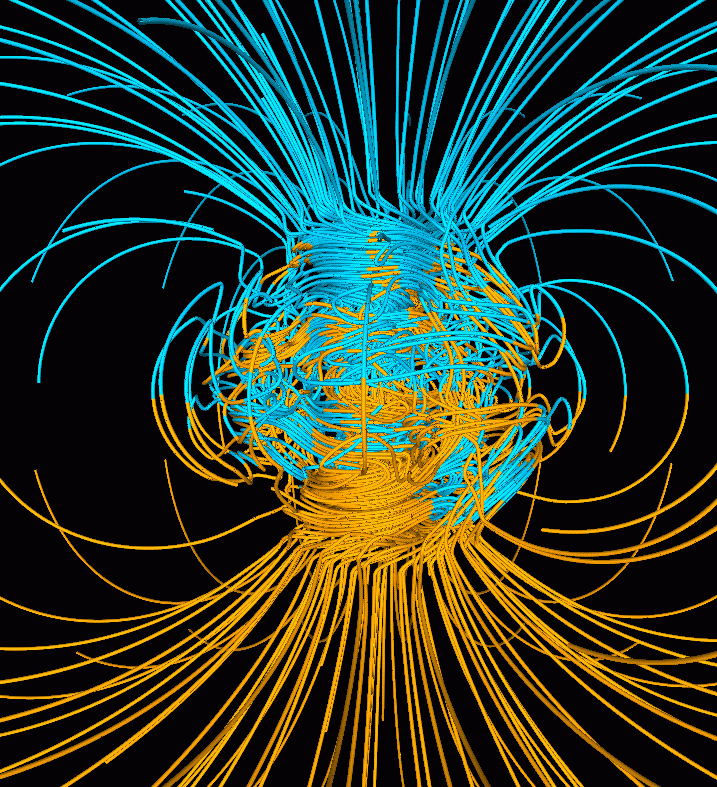
The magnetic field (according to current theories) is created from the turbulence and movement of the molten metal in the inner and outer cores.
[Message Edited]
The magnetic field (according to current theories) is created from the turbulence and movement of the molten metal in the inner and outer cores.
[Message Edited]
Aleatoric
Reply #19 Monday, December 29, 2003 4:55 PM
Reply #19 Monday, December 29, 2003 4:55 PM
Here's a model image of the earth's magnetic field.
aufisch
Reply #20 Monday, December 29, 2003 4:55 PM
Reply #20 Monday, December 29, 2003 4:55 PM
Many biologist would not aggre with you. If only we would actually know all these things, instead of just being comfortable about it. Remember, for hundreds of years humanity was very comfortable with thinking that earth was a disc in the centre of the universe 
That's why I said, it just shows us how much we still have to learn.

That's why I said, it just shows us how much we still have to learn.
Please login to comment and/or vote for this skin.
Welcome Guest! Please take the time to register with us.
There are many great features available to you once you register, including:
- Richer content, access to many features that are disabled for guests like commenting on the forums and downloading skins.
- Access to a great community, with a massive database of many, many areas of interest.
- Access to contests & subscription offers like exclusive emails.
- It's simple, and FREE!
|
|
Page 1 of 3 | |
|
|---|
Reply #1 Monday, December 29, 2003 1:20 AM
I disagree with the expansion of the earth theory, but it makes me wonder about the validity of plate technotics.